
Every Month, You Get The Score
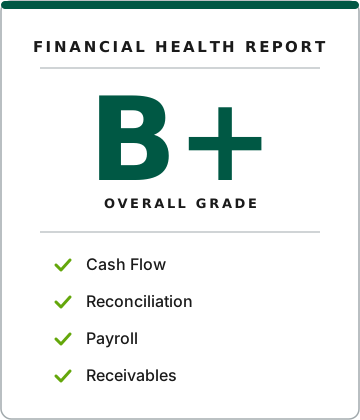
The Score is a graded report on your business's financial health, delivered every month alongside your financials. Eight categories, letter grades, plain English. It tells you where you stand, what changed since last month, and what to do about it. Most bookkeepers hand you a P&L and consider the job done. This is the part that tells you what the P&L means.

Why a Grade Instead of a Report
Most business owners get handed a profit and loss statement and a balance sheet every month. They glance at them, they don't know what they're looking for, and the reports go in a folder.
That's not a failure of the owner. Nobody ever told them what good looks like.
A letter grade does. You already know what a B-minus means. You know it without being taught, and you know immediately whether you're happy with it. That's the whole idea — take the thing every owner should be tracking and put it in a format nobody has to be trained to read.
What Gets Graded
Eight categories of financial health, scored monthly:
- Whether your books are current and reconciled
- Whether your cash position supports how you're operating
- Whether your receivables are being collected or quietly aging
- Whether your margins are holding or drifting
- Whether your expenses are behaving the way they did last month
- Whether your payroll matches what actually left the bank
- Whether your records would survive an outside review
- Whether you could make a real decision from your numbers today
You get a grade on each one, a grade overall, and a short plain-English read on what moved and why.
Three Things Most Bookkeeping Never Gives You
A fraud screen. A statistical pass over your transactions looking for patterns that shouldn't be there — including a Benford's Law analysis, which checks whether your numbers have the mathematical fingerprint that honest numbers naturally have. This is the Trusted Eyes layer, and it runs every month.
Read how it works →A valuation range. A defensible starting point for what your business is worth, kept current month to month instead of guessed at in a hurry the week somebody asks.
Lender readiness. Whether your books would hold up if a bank asked for them. Most owners find out the answer during the loan application. That is the worst possible time to find out.
The Score also carries tax-awareness flags. Those are pointers for a conversation with your CPA — Ensemble does not prepare or file taxes.
Who Gets It
Every Ensemble client, every month, starting after we've closed your first clean month. It isn't an upgrade and it isn't an add-on. If we're doing your books, you're getting The Score.
Frequently Asked Questions
When do I get it?
Every month, once the month is closed and reconciled. You'll get the report and a short walkthrough video you can watch on your own time — so it isn't just a document you mean to read.
Do I need to understand accounting to read it?
No. That's the point of grading it. If a category drops, the report says what dropped and what it means, in the same words you'd use.
Is the valuation an appraisal?
No. It's a range built from three standard methods, useful for orientation and planning. If you're actually selling, you want a formal valuation — and this gives your appraiser a much better starting point than a shoebox.
What if my grades are bad at first?
Most are. That's the honest answer. The first Score is a baseline, not a verdict, and the useful part is watching it move.
Your Health Score is the free preview of The Score.
Eight questions, two minutes, and you'll see the shape of what a full month looks like.
Get Your Free Health ScoreOr let's talk — thirty minutes on Zoom, straight answers about your books.